Replacing Manual PDF Extraction with Agentic AI: 80% Reduction, Two Weeks to Production
Originally published on the Tecknoworks website, May 2026.
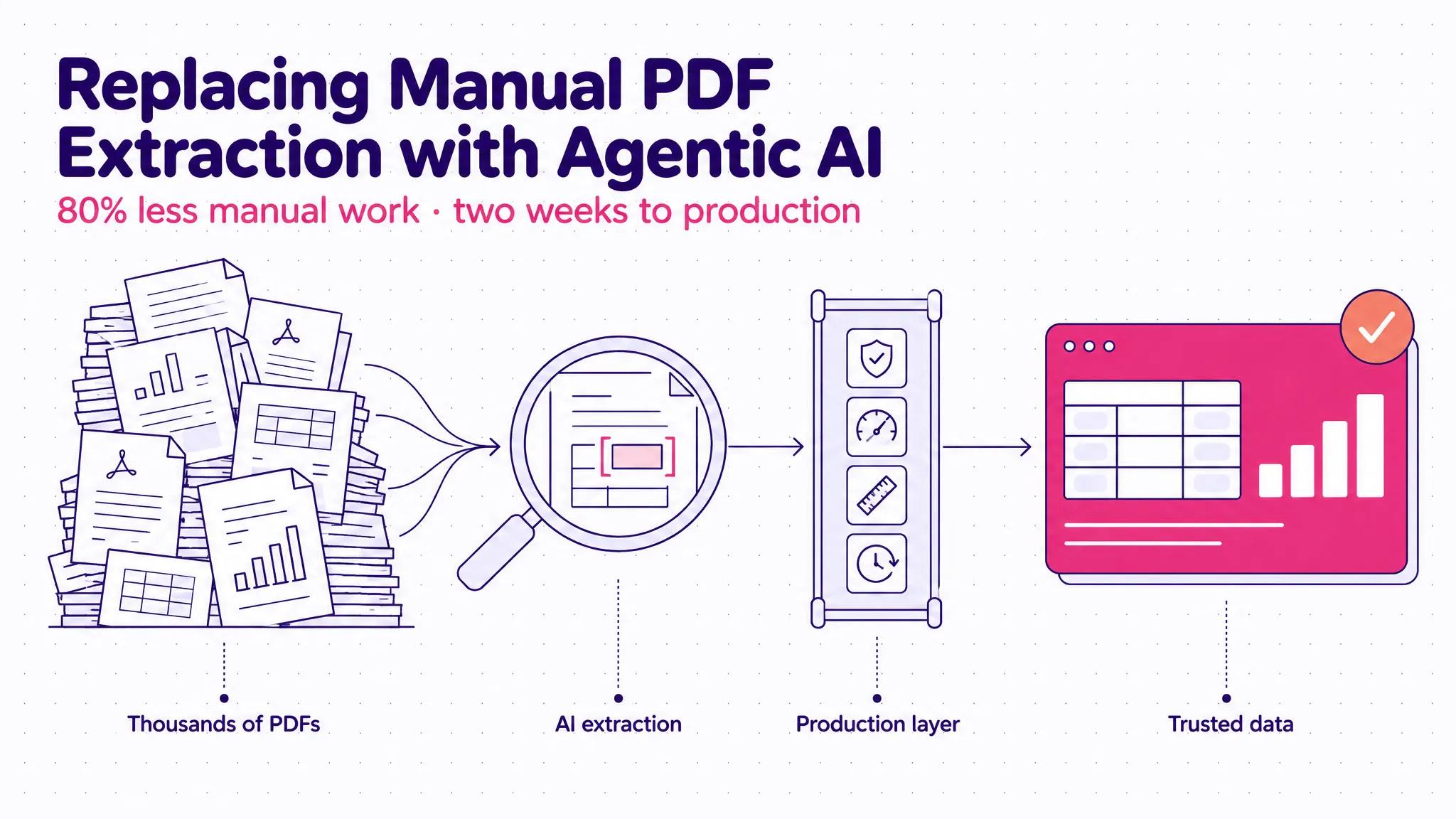
Client: Top-three global management consultancy providing operational intelligence to mining companies.
Industry: Mining intelligence.
My Role: Led the engagement at Tecknoworks.
Most enterprise data isn’t in databases. It’s in documents.
Technical reports, mining documents, handwritten notes — the operational knowledge that should be driving decisions sits in file libraries nobody can search efficiently. AI changes that math. The capability isn’t experimental anymore; it’s a few weeks of focused work, not a moonshot. But the model isn’t where these projects live or die.
The problem: thousands of PDFs, all manually searched
Our client provides operational intelligence to mining companies — production volumes, reserves, recovery rates, development stages. Hundreds of mines, updated regularly. Mining executives rely on this data to make real decisions about where to invest, where to cut, and where the gaps are in their operations.
But getting to the data was slow.
Every day, a team of analysts opened a PDF search software and started hunting. Thousands of documents. A data point buried in a table on page 47, or halfway through a technical report. If it wasn’t there, open the next document. And the next. Multiple people doing this, all day, across hundreds of mine records.
They were paying for an expensive PDF subscription just to search. And still falling behind on coverage.
The solution: a production layer around the AI
As part of the project, an AI capability was introduced to read mining documents and extract key data points. The model was progressively built and refined throughout the integration, evolving alongside the system itself.
But a model on its own doesn’t help an analyst at 8am who needs to update 30 mine records before lunch.
We embedded that intelligence directly into the tools their analysts use every day — with pre-filled fields, confidence scores, source citations, and an approval workflow that lets people review and accept instead of search and type. And they needed it fast.
The trust layers that made the system production-grade:
- Validation that catches bad values before a reviewer sees them
- Confidence scoring so analysts know which fields to trust on sight
- Unit standardization across 500+ conversion rules
- Audit trails that survive every edit
- A senior review workflow before data hits production
Without those layers, the “AI solution” would have sat next to the existing process instead of replacing it, and the cost would have stayed.
The whole system went live in two weeks. Not a pilot — production, with real data and real analysts using it from day one.
What changed
Manual data gathering time dropped by over 80%. Analysts shifted from searching to reviewing. The PDF software subscription got cancelled. Every data point now traces back to its exact source — which was impossible to maintain consistently by hand.
The client’s roadmap now includes scheduled AI extraction runs and self-learning feedback loops, built on the infrastructure we delivered.
Looking beyond the model
The AI was 20% of the problem. The other 80% was production engineering: making the model work inside an existing product, with real validation, real traceability, and a UI that analysts actually trust.
This pattern shows up everywhere. Organizations invest in AI capabilities that perform well in isolation. The models work. The demos are convincing. But when it’s time to connect that capability to production systems, handle real-world data at scale, and deliver results people can verify and act on, the investment stalls. The gap between a working model and a working product is almost always an engineering problem, not an AI problem.
The question is rarely whether the model is good enough. It usually is. The question is whether the production infrastructure exists to make it trustworthy at scale.
The AI was the easy part. Building the trust layer around it is what made the math work.
Have a Model That Isn’t a Product Yet?
If your AI performs well in isolation but stalls on the way to production — validation, traceability, integration with the systems people actually use — I’m happy to talk it through. This is the kind of work I lead at Tecknoworks, and a short conversation is usually enough to tell where the gap is. Reach out on LinkedIn, email me at evgeni.n.rusev@gmail.com, or contact Tecknoworks directly.